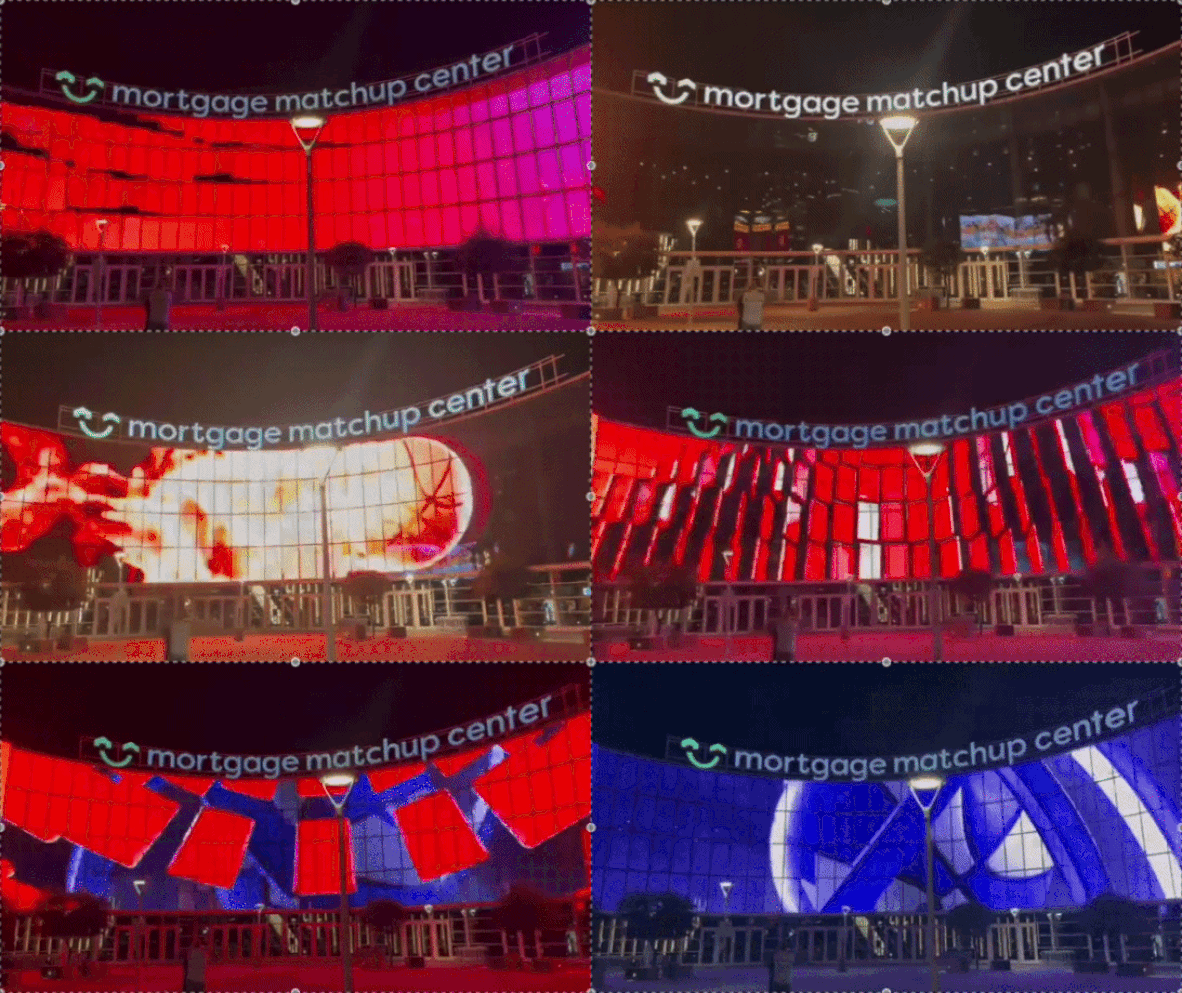
Those working in the digital signage space can attest that the technology has come a long way. In fact, one wonders whether we should still be calling it signage, given the role it plays in communications and operations today.

Joseph Mendonca, director of business development at AVI-SPL, observed that digital signage has moved beyond being a screen-based messaging medium, as an increasing number of organizations are leveraging the technology to provide intelligent, integrated digital experiences. “What was once a standalone communications tool now plays a critical role in workplace communications, operational awareness, employee and customer engagement, and data-driven decision-making,” he noted.
This is being driven by several developments, Mendonca noted, including AI and automation, cloud adoption, compliance and security requirements, and more sophisticated display and media player systems. He also highlighted the evolution of end-to-end content workflows.
“Modern platforms now integrate seamlessly with existing communications, workplace management, operations, and collaboration technologies, enabling organizations to deliver the right information to the right audience, at the right time, with minimal manual effort,” he said. In other words, for many companies, digital signage is a core component of their communications strategy, be it inward or outward facing.
Technology Boost
Innovation in LED, microLED, and ultra-high-resolution display technologies are also changing the digital signage landscape. In particular, Mendonca said microLED is well-suited for environments with high ambient light—including corporate offices, stadiums, and transportation hubs—thanks to high brightness and contrast, energy efficiency, and longevity.
Companies are also taking advantage of 8K, glasses-free 3D, holographic displays, and transparent LED walls for immersive experiences. Flexible or rollable screens, ideal for curved surfaces, serve as standout architectural features.
Systems have also matured to the point where digital signage content is truly dynamic. “[There are] more and more interactive scenarios where content is both live and [coming in] from different types of sources so that you can really animate all the elements of the screen in an automatic or interactive way,” said Francesco Ziliani, CEO at SpinetiX.

Joseph Mendonca
Image credit: AVI-SPL

Misty Chalk
Image credit: BrightSign

Francesco Ziliani
Image credit: SpinetiX
These capabilities have led to the combination of live streaming with more traditional digital signage content. For example, a soccer match may be broadcast in real time with a ticker featuring statistics on the players. “Before, you were forced to choose between streaming [or displaying the stats]," Ziliani explained. "Now it’s hybrid.”
Amber Ward, marketing director at Carousel Digital Signage, noted that a growing number of companies are engaging more than one digital signage content creator for their strategic marketing and communications efforts. This has led platform providers like Carousel to support multiple contributors across departments, people who are already accustomed to creating messages with industry standard software. “To make that possible, CMS providers are adding more integrations and familiar tools that simplify content creation and collaboration,” she said.
Managed Services
While small and mid-sized organizations often keep digital signage management in-house, many—especially those with large campuses, national firms with multiple locations, and global enterprises—opt to outsource to a third party. According to Mendonca, the main reason for this is the need to lighten the workload for AV and IT personnel.
“Managing platform operations, device fleets, content workflows, security, compliance, and ongoing support places significant strain on internal IT, AV, and communications teams,” he said, adding that his firm is witnessing increased demand for managed services from Fortune 500 and global organizations in financial services, government, healthcare, higher education, hospitality, and retail. “[These are markets] where digital signage is evolving from a point solution into a mission-critical component of the digital workplace and customer experience ecosystem.”
For Misty Chalk, VP of sales for the Americas at BrightSign, more clients are expecting their AV partners to provide managed services. In the client’s eyes, it renders AV integrators more accountable for the systems they deploy.
“I think that people are recognizing that if you have an unmanaged signage network, that’s not a strategy,” Chalk said. “Everything is now networked and connected, and people want someone that’s going to manage the entire fleet as well as everything else on their network.”
AI for Everything
Initially, organizations began experimenting with AI for digital signage content creation. According to Mendonca, companies these days have expanded their application of AI for automation, governance, and localization, as well as for the delivery of more personalized messaging. “Beyond content creation, AI is transforming how signage networks are operated and evolved, enabling intelligent workflows, policy-driven governance, and continuous optimization with far less manual effort,” he said.

AI is also augmenting interactive displays with the adoption of kiosks that support conversational AI and virtual assistants, as well as smart wayfinding featuring real-time navigation and multi-language support. This, combined with AI-powered analytics, enables companies to be more strategic in communicating with their target audiences.
“These capabilities allow digital signage to adapt dynamically to users, locations, and context, delivering more meaningful and inclusive experiences,” Mendonca said. “Organizations gain the ability to make data-informed decisions, communicate more intelligently, operate more efficiently, and continuously improve employee and customer experiences across the digital workplace.”
Still, according to Ward, AI has made digital communication more difficult to believe. “It’s becoming harder to tell what’s real, what’s generated, and what’s trustworthy,” she said.
Ward argued that organizations can position their digital signage messaging as more meaningful than the noise their audience receives from other outlets. “In corporate and education environments especially, signage networks have become trusted, curated channels, and a reliable source of information employees and students know they can count on,” she noted.
Keeping It Secure

Amber Ward
Image credit: Carousel Digital Signage

Jason Cremins
Image credit: Navori Labs
Because a growing number of digital signage systems are cloud-based and deployed across multiple locations, they are exposed to the same risks as any other technology that sits on a network. While Mendonca acknowledged that today’s CMS platforms incorporate security protocols and standards such as encryption, ISO 27001, role-based access control, single sign-on (SSO), SOC 2 Type II, and zero trust architectures, this isn’t enough to keep systems safe.
“Integrators are no longer just deploying hardware—they serve as a critical bridge between AV, IT, and information security,” Mendonca said. “They must help organizations design, implement, and govern a secure digital signage architecture that aligns with corporate security policies, network segmentation strategies, identity management, device hardening, and long-term operational compliance.”
Jason Cremins, chief product officer at Navori Labs, advises AV integrators to consider these security best practices for their deployments:
• Adopt strict authentication and access control protocols.
• Apply HTTPS/TLS encryption for API calls, data transfers, and remote management.
• Don’t deploy any external APIs, apps, or widgets before vetting them for security compliance.
• Implement a rigorous schedule for firmware and software updates.
• Pay attention to the physical security of hardware, and avoid tampering by locking enclosures and protecting cables, especially in high-traffic areas.
• Segment the digital signage infrastructure from the main business network to reduce exposure to attacks.
• Set up centralized logs and real-time monitoring for threat detection.
“By prioritizing security at every stage of integration, AV integrators can deliver digital signage solutions that are effective and resilient against evolving threats, strengthening reliability, compliance, and customer trust,” Cremins said.
Best Practices
For a digital signage deployment to be successful, it’s necessary to start thinking of the future in the earliest planning stages of a project. When systems are designed for scale up front, the need for expensive reconfigurations down the road is significantly reduced. “Systems almost always grow to include more screens, more locations, more users, and more content,” Ward advised.
It’s also necessary for AV integrators to consider their relationship with the customer beyond deployment, Chalk emphasized. “They want somebody that’s going to be able to manage this all the way through and not just on day one,” she said. “We’re going to see a big shift in 2026 where it’s not going to be a single install anymore. Services are what’s going to matter, [and] that’s what people are going to start basing their decisions off of.”