Quick view:
- To perform in a noisy exhibition hall, the setup pairs an Audio-Technica directional microphone and tuned threshold gates with a 7,680 Hz refresh rate, 1.5mm pixel-pitch AOTO Mini-LED wall driven by Brompton processing.
- Rather than waiting for full text and audio generation to finish, the software coordinates a continuous streaming pipeline—linking speech-to-text, LLM response generation, voice synthesis, and lip-sync in parallel chunks.
- The system balances heavy remote inferencing with high-performance edge rendering. Off-site processing runs in a Spanish data center powered by eight NVIDIA RTX PRO 6000 Blackwell GPUs (768 GB total VRAM) and dual AMD EPYC CPUs, while on-site operations are driven by an externally liquid-cooled laptop packing an Intel Core Ultra 9 275HX, an RTX 5090 (24 GB GDDR7), and 96 GB DDR5 to run real-time Unreal Engine 5 facial capture and 60 fps lip-sync.
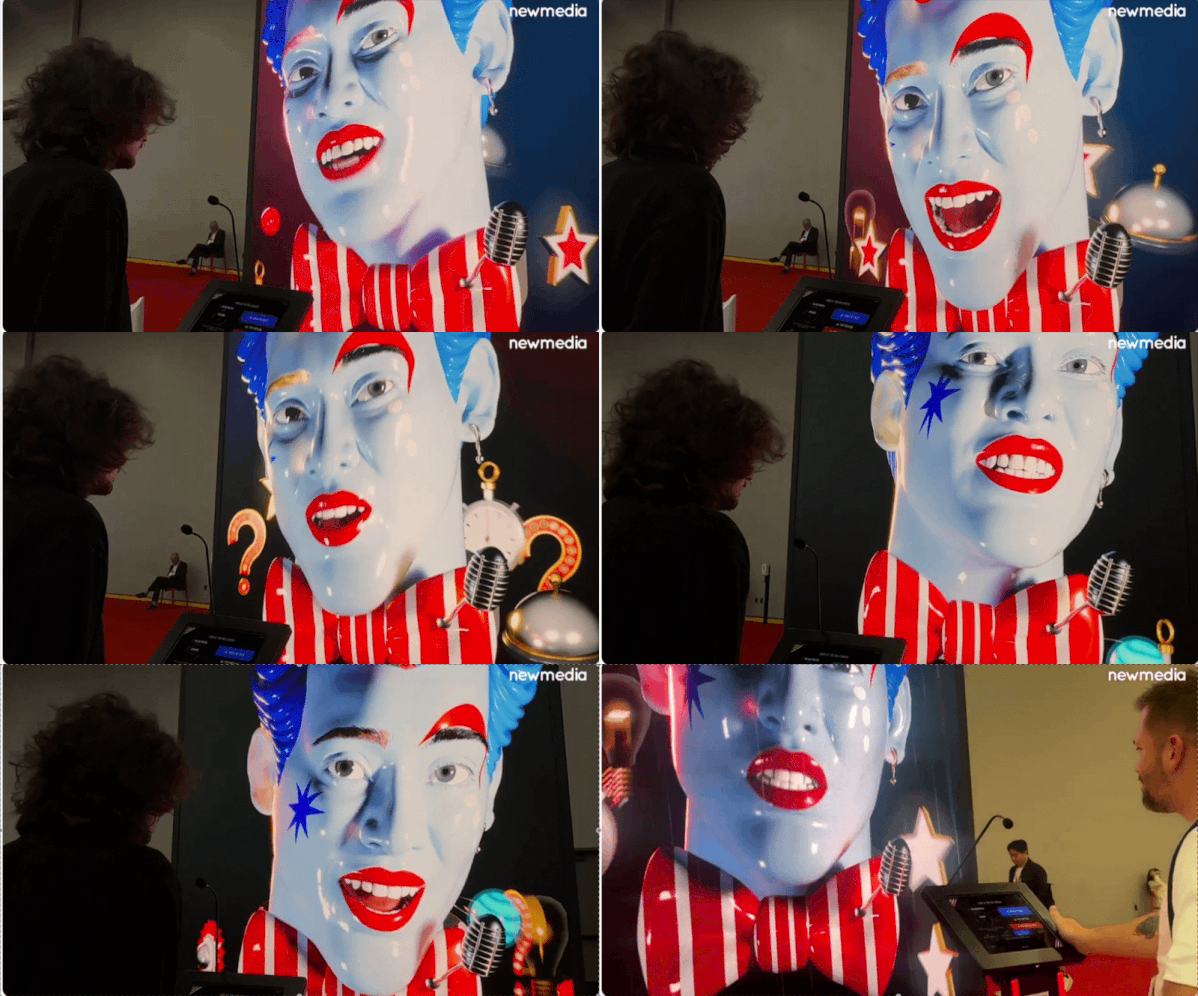
NewMedia Creative Technology Studio combined a large LED character, directional voice capture, and remotely hosted AI processing for AI HOST, its interactive installation at IMEX America 2026. The system brought several stages of speech processing and character animation into a public conversation, with the studio reporting a median of 2.6 seconds between a visitor's last word and the start of the character's reply.
The installation at the company's stand used a 6x12-foot LED wall, built with AOTO RM1.5E panels and driven by Brompton processing. NewMedia specifies the panels at 1,500 nits, with Mini 4-in-1 LED technology, 1/16 scan, and a 7,680 Hz refresh rate.
A 12.9-inch iPad ran a touchscreen interface developed in-house. Visitors selected one of four characters, entered their name and started speaking through an Audio-Technica PRO49QL gooseneck microphone. A JBL stereo system reproduced the character's voice, while facial animation and lip-sync gave the generated response a visual performance on the LED wall.
The on-site show computer was a custom laptop equipped with a 24-core Intel Core Ultra 9 275HX processor and an NVIDIA GeForce RTX 5090 Laptop GPU with 24 GB of GDDR7 memory. Its configuration included 96 GB of DDR5 memory and a 4 TB PCIe Gen 5 SSD. External liquid cooling formed part of the laptop setup.
The show computer ran Unreal Engine 5 for real-time facial animation and lip-sync, with a specified frame rate of 60 fps. This was paired with NewMedia's own AI infrastructure in a data center in Spain, accessible to the team remotely.
The studio's dedicated AI server specification lists eight NVIDIA RTX PRO 6000 Blackwell GPUs with 768 GB of combined GPU memory, dual AMD EPYC server processors and 1 TB of ECC system memory. Enterprise NVMe storage completes the server configuration.
Take a look at it in action in the video below.

