Quick hits:
- Brompton Technology’s 4K Tessera SX40 LED processors and Tessera XD 10G distribution units powered the visual clarity, color accuracy, and contrast needed to render the piece's complex pixel structures and deep black backgrounds.
- Artist Kim Asendorf, who builds software art intended for universal device playback, noted that Brompton’s system's "almost surreal" display quality, making Brompton controllers his preferred setup after first using them at Art Basel Miami Beach.
- The project highlights an ongoing shift in contemporary digital art, where processing hardware is treated as an active part of the artwork rather than a passive display screen.
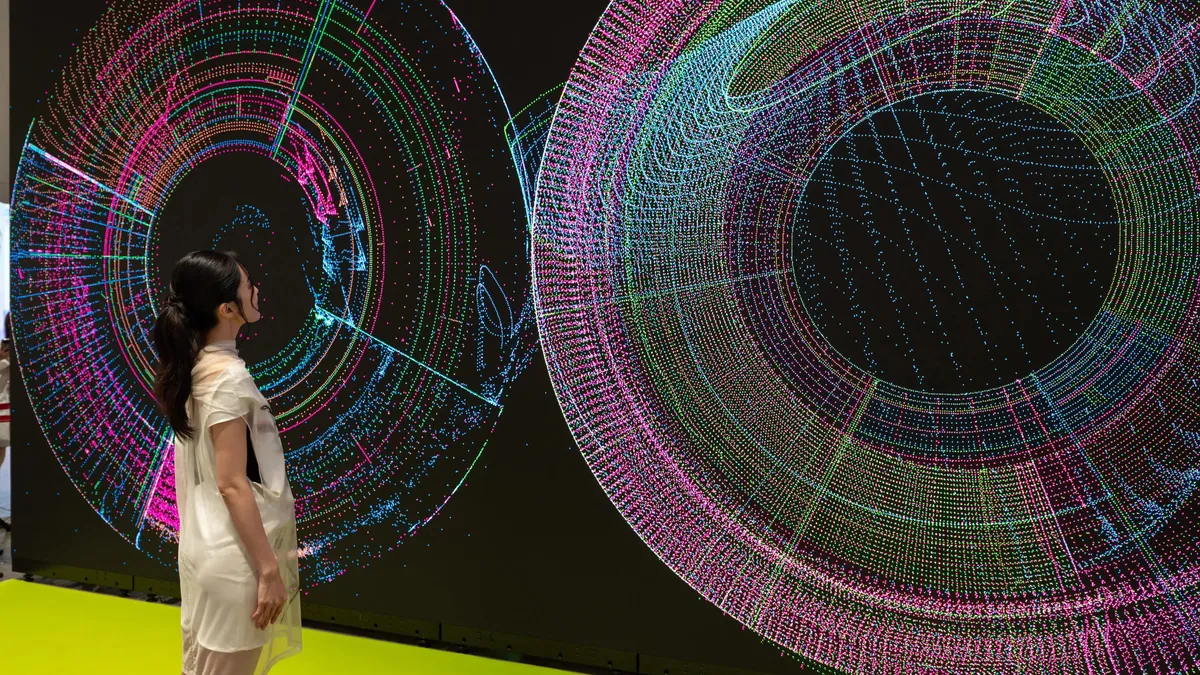
Brompton Technology’s Tessera LED processing recently helped bring German visual artist Kim Asendorf’s PXL DUO POD to life at Art Basel Hong Kong, delivering the color, depth, and precision required to present its evolving pixel structures on a large-scale interactive LED installation.
Presented by New York and London-based contemporary art gallery Nguyen Wahed, PXL DUO POD formed part of Zero 10, Art Basel’s global initiative dedicated to art of the digital era. A special development within Asendorf’s expanding PXL ecosystem, PXL DUO POD followed PXL DEX, the first work in the series, and its cylindrical successor, PXL POD. Asendorf developed the Duo version after discovering an unexpected visual relationship when viewing two PXL POD works adjacent to one another.
Presented across two LED screens positioned side by side, PXL DUO POD placed two evolving systems alongside one another, allowing their colors, movement and pixel density to interact. Visitors could use a control pad to rotate the forms, zoom in and alter the camera angle, directly influencing how the work was experienced.
For the Hong Kong presentation, a ROE Visual Topaz 2.6mm LED system was driven by Brompton’s 4K Tessera SX40 LED processors and Tessera XD 10G data distribution units. The combination enabled the work’s individual points of light, carefully developed color palettes, and deep black backgrounds to be reproduced with the clarity required to preserve its spatial qualities and constantly changing detail.
“I create software art meant to run on every device. Brompton Technology changed my mind,” said Asendorf. “I care deeply about display quality, but what Brompton controllers bring to LED walls is almost surreal. Now I have a first-choice setup.”

Asendorf’s relationship with Brompton began at Art Basel Miami Beach, where his work Raster und Spektrum was presented during the inaugural Zero 10 program. Following Asendorf’s meeting with the Brompton team at a demonstration in London, the gallery requested that Brompton’s processing technology be used for his Miami Beach presentation. Fuse Technical Group provided technical management and introduced the project team to Absen. As a result, Absen LED panels were used for the exhibition, paired with Brompton LED processing to deliver the deep blacks and pixel separation essential to Asendorf’s work.
The progression from PXL DEX, through PXL POD to PXL DUO POD reflects a wider shift in contemporary digital art, where software, interaction, physical installation and display technology all contribute to the artwork. The screen is therefore more than a surface for presenting a finished image, making accurate color reproduction, contrast, motion and processing essential to preserving the artist’s intent.
“I was fortunate to be in the room when Kim visited our London headquarters with Matthew,” concluded Rob Fowler, director of business development at Brompton Technology. “It was fascinating to learn more about this rapidly growing area of art as well as see how the work we have been doing over the lifetime of Brompton Technology to enhance accuracy and faithful image reproduction dovetails with the work Kim is creating.
“Seeing his response to our Tessera platform, and the pleasure he took in viewing his work rendered on LED using features we have developed over more than a decade, was hugely gratifying. It demonstrated how processing can become integral to the way an artwork is experienced, rather than simply a means of displaying content.”

