Details:
- A new live action projection mapping film 'Texas Legacy in Lights' was captured with Blackmagic URSA Cine 12K LF and Blackmagic PYXIS 6K digital film cameras.
- Director John Franklin Rinehart of Austin Film Crew created the project for the Gonzales Memorial Museum.
- The team used DaVinci Resolve Studio across editing, color grading, visual effects (VFX), and audio post production, with Rinehart citing DaVinci Resolve Studio’s all in one toolset as crucial to achieving the tight 45 day turnaround for post.
‘Texas Legacy in Lights’ Uses Blackmagic Designs Digital Film Cameras for Projection-Mapped Film
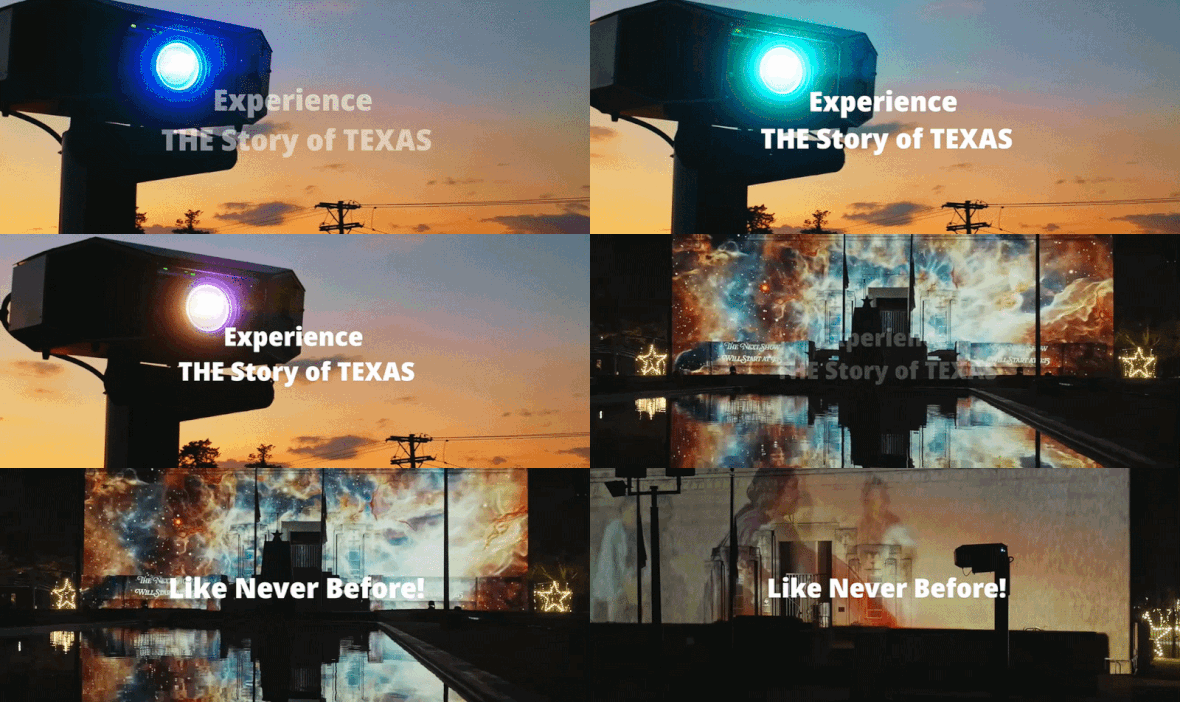
Director John Franklin Rinehart of Austin Film Crew recently created a film for the Gonzales Memorial Museum, producing a new, narrative film that’s projected twice a day against the large exteriors of the museum. The live-action projection-mapping film Texas Legacy in Lights was captured with Blackmagic URSA Cine 12K LF and Blackmagic PYXIS 6K digital film cameras.
[WATCH: Projection Mapping Lights Up the White Cliffs of Dover]
Rinehart collaborated closely with DP Alex Walker for the project. “When we first conceived Texas Legacy in Lights, the world’s first live action projection mapping film which covers the Texas Revolution of 1835, there were a lot of technical questions and challenges that came up right off the bat," he explained. "Alex and I were pioneering something together, solving problems that didn’t yet have answers. There were moments on set where we’d look at the monitor and realize we were capturing something that had never existed before."
The project’s main challenge was how to properly shoot for the architecture of the Gonzales Memorial Museum, which is 96x32 feet, approximately one-and-a-half times the size of an IMAX screen.
“When you’re shooting for projection mapping, you’re shooting for the architecture of the building itself," explained Rinehart. "We picked different points in the building’s architecture and different surfaces that would house various parts of the story, with the plan to blend the images together so that you could see the whole narrative on one giant canvas. In a way, we were shooting multiple films simultaneously and then compositing them into a single experience.”
Rinehart selected the URSA Cine 12K LF as the A camera due to its large format RGBW sensor, oftentimes shooting with up to five URSA Cine 12K LFs at once. He noted the PYXIS 6K was an ideal workhorse B camera, complementing the URSA Cine 12K LFs. The URSA Cine 12K LFs’ sensor quality and high resolution capabilities were paramount, since the team had to shoot very wide to allow for the building’s architecture.
“Having the ability to crop into the image became the backbone of our editing process," Rinehart said. "Since we had that extra resolution, we were able to be very creative in how we problem solved in post, in a way that no other cameras currently on the market would allow."
An example Rinehart provided was when they would use a tight shot on the right of the building and a wide shot on the left, showing the exact moment from two different framings simultaneously. In traditional filmmaking, these are shots you would usually cut back and forth between. But in this case, both images were playing simultaneously. The audience on the left side of the museum would have a different experience from those on the right.
“To make that work, we needed to shoot wide because there are different areas of the building’s architecture, and if you let the image bleed over, it ends up distorting," Rinehart added. "You have to mask out a window or other architectural elements, so the image almost seems to sit behind the architecture rather than fighting against it. To do that, you need a lot of latitude in your image to punch in and reframe. That’s where the URSA Cine really came in handy.”
The scale of the project often required five URSA Cine 12K LFs shooting simultaneously, all capturing one take. Rinehart explained: “We put our whole building together like a mosaic. Different façades yielded different images at various times, so if we wanted the entire image to come from a single scene, we needed five angles shooting simultaneously.
According to Rinehart, the cameras continued to prove themselves in post. “That’s when I was like, ‘Wow, this is really spectacular,’” he commented. “From a projection mapping perspective, having that latitude in post was crucial. We shot in Blackmagic RAW, which is second to none in terms of how lightweight it is and how well it works inside Resolve.”
The team used DaVinci Resolve Studio across editing, color grading, visual effects (VFX), and audio post production, with Rinehart citing DaVinci Resolve Studio’s all in one toolset as crucial to achieving the tight 45 day turnaround for post.
Since the film was projected on the side of the building, grading had specific challenges, with Rinehart noting: “With projection mapping, you don’t have a beautiful white screen. We were projecting onto a weathered sandstone museum with aging, color variations and surface inconsistencies. Each image had to be color corrected specifically for the part of the building it would hit.”
The team noted DaVinci Resolve Studio’s AI noise reduction tools were crucial for the scenes in low light. “We had a lot of nighttime and candlelit interior scenes, and the noise reduction tools handled it all beautifully without destroying detail. We could push those shots further than I’ve ever been able to before while keeping them clean. That kind of capability meant we weren’t limited creatively by technical constraints,” said Rinehart.
“This film, beyond its technical breakthroughs, wouldn’t be anything to talk about if we hadn’t been able to properly tell the story and let people know it won’t be forgotten," he concluded. "The cameras, the resolution, the workflow, all of that served a larger purpose. We built something permanent for a community that deserves to have their story told on the same scale and ambition usually reserved for major cities, and that’s what makes all the technical problem solving worth it.”

