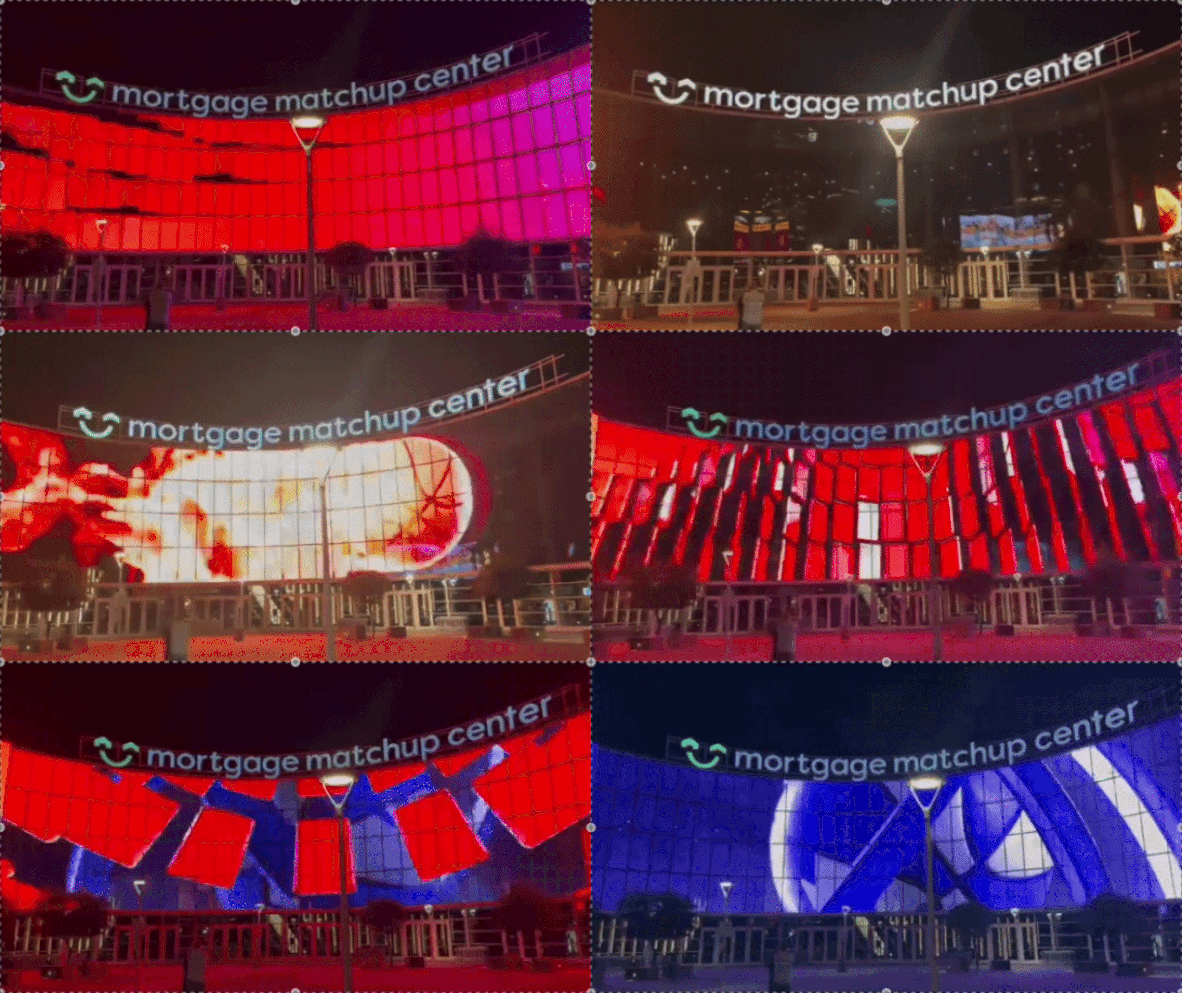
While Las Vegas turned up temperatures for InfoComm 2026, the show made its own heat. There was serious energy on the show floor, with plenty of exhibitors, presentations, and experiences to keep attendees engaged. The completed renovations to the Las Vegas Convention Center helped traffic flow between the Work (Central Hall) and Play (North Hall) areas, with free session spaces and other attractions positioned between the two.
[What's the Buzz? How InfoComm Has Changed in Five Years]
First, let's talk about those show numbers. I said it on the show floor and I'll stand by my assessment: Attendance was fine. Not record-breaking, not a disaster. Fine. Normal. Within acceptable parameters.
The official numbers back me up. According to AVIXA, there were 28,132 verified attendees (35,707 total registrants). International attendance accounted for 20% of attendees, with representation from 94 countries. There were also 807 exhibitors.
How does that compare to last year's effort in Orlando, FL? InfoComm 2025 attracted 817 exhibitors, which was down from 833 in 2024. So, yes, there's a small downward trend, but 807 still gave attendees plenty to experience.

Orlando attendance was 30,998, and InfoComm 2024 in Las Vegas was 30,271, which reported 23% international attendance. That little nugget of data is important. Based on these numbers, a quick bit of math shows me the show lost about 1,300 international attendees from the last time we all gathered in Las Vegas, which represents roughly 60% of the attendee loss.
What kept them away? Was it outrageous travel costs? International unrest? The growing popularity of ISE in Barcelona? Methinks it's all of the above.
Speaking of numbers, Michael Sullivan-Trainor, AVIXA’s senior industry analyst, reported during the show that growth in the Pro AV industry has slowed from 5.4% to 3.9%, but it's still ahead of GDP in most countries. Even more encouraging: Pro AV buyers are increasing budget growth expectation this year. Here are a couple of other things I noticed on the show floor.
Don't sleep on virtual production.
If you haven't heard, there's a buzzword gaining momentum in Pro AV: broadcast AV. (You can get some insights from our recent ebook, AV for Broadcast.) During a presentation for media covering the show, Sullivan-Trainor said the growing broadcast AV market is changing the way the industry is looking at delivering AV. In fact, broadcast production rooms that deliver high production values are being adopted across other verticals, including corporate, government, healthcare, education, and more.
According to Trainor, the core principles of broadcast AV include workflows that offer repeatable execution, not just ad hoc operations, with enterprise-first designs that are focused on business teams and are aligned with IT requirements. And virtual production is a "very important" part of the growing broadcast AV market segment. He mentioned one company that embraced virtual production and was producing content 30% faster as well as 40% more content. That kind of ROI is hard to ignore.

Sony gets it. The company has developed a comprehensive virtual production ecosystem, and partnered with Vū Tampa Bay to demonstrate a setup designed for corporate users during the show. The solution featured Sony's CAPRI modular dvLED display, which can be upgraded to a VERONA display with a lower pixel pitch and deeper blacks. Both are purpose-built Sony Crystal LEDs for virtual production. The demo also had a BRC-AM7 PTZ camera with AI integration for tracking and facial recognition.
Jaime Raffone, senior sales manager, virtual production, Sony, said the demand for virtual production at the corporate level is "growing exponentially," because it offers a "very easy point of entry." Many financial and Fortune 500 companies have already adopted virtual production workflows and are now building out their facilities for more complex productions. "Content is still king," Raffone offered, adding that virtual production provides an "easier, more immersive way to build their brand."
A virtual production set was also part of the Smart Workplace, which was powered by FORTÉ and showcased modern office technologies. It was one of three new immersive experiences at the show; there was also the Pitch, powered by Diversified, which provided a look at the modern fan experience, while the Retail Experience demonstrated how Pro AV technologies are influencing consumer engagement in physical retail environments.
Stop trying to bury the projector business.
Yes, the projector business is not en fuego. Robert Ambrose, CEO and co-founder of Caretta Research, took a quick look at the numbers for me. The market is not showing a positive trend; in fact, it's on the decline at a roughly 5% drop annually. But it ain't dead yet.
According to Petro Shimonishi, director of new business development and business transformation for Panasonic Projector & Display Americas, the market oscillates between flat and declining, depending on the year. Except this year—because sales are up. She's seeing customers "boomerang" from dvLED solutions due to the cost and complexities of maintenance issues.

Panasonic is also investing in a new projector technology. VIVID PRIME is a RGB laser light source technology that's designed to eliminate the "rainbow effect" without introducing new imaging issues. The new PT-HTQ20 4K projector is the company's first to feature VIVID PRIME, and is designed to appeal to museums, themed entertainment, and immersive experiences. Shimonishi said the company is also seeing new interest from golf simulation systems that rely on projectors. Obviously, you can't launch a golf ball at a dvLED display—or at least not more than once.
Joel St-Denis, director of project management at Christie, admitted concerts and live events have been "taken over" by LED. However, he said, "There's still growth in certain areas." Fixed installations are a bright spot, particularly with projectors in the 8,000-12,000 lumen market space. St-Denis said these models, including Christie's new Korus Series, are bright enough to punch through ambient light while providing competitive price points.
And then there's projection mapping. Scalable Display Technologies had a patriotic demonstration of projection mapping on a scaled version of Mount Rushmore at its booth. From monuments to historic structures, projection mapping brings existing spaces to life. "I think it's reinvigorating production," said James Pietsch, director of global accounts, Scalable Display Technologies.

ViewSonic launched its LSD Series of laser projectors in May and had three models on display at InfoComm. Jeff Muto, business line director, ViewSonic, said the lumens-per-dollar ratio has improved with the company's third-generation laser technology, so ViewSonic can deliver a more viable product for schools and small businesses. (And yes, they have a dedicated Golf Mode, too. I sense another trend.)
Muto also admitted the professional projector market is "slowing," but with relatively few projector manufacturers in the industry, there's no reason to abandon the technology. And slowing doesn't mean stopped; globally, this is still a multi-billion dollar industry. So, plenty of sales, new technological developments, new products, and new potential markets and applications. Sure doesn't sound like a dead market segment to me.